Monday, May 17, 2010

Ibero American Cinema at Harvard


El cine como historia; la historia como cine: Simposio internacional sobre cine iberoamericano
was held at the Harvard University Film Archive from May 7-9, 2010.

Among the many presenters were Néstor García Canclini (UNAM), who wondered (as did other presenters) whether there is such a thing as Ibero American cinema in this age of co productions, television-sponsored films (HBO), and international financing. Juana Suárez (Univ. of Kentucky) and Gonzalo Aguilar (U. Buenos Aires) spoke about the international and multi-national nature of Ibero American film as well.

Historical memory and documentary film in Spain was a major topic, addressed by Ignacio Oliva Mompeán (Univ. de Castilla-La Mancha), Francisco A. Zurian (Univ. Carlos III) and Josetxo Cerdán (Univ. Rovira I Virgili). Oliva Mompeán discussed films made outside of Spain that address events of the Spanish Civil War: Muerte en el valle (Cristina Hardt) and Land and Freedom (Ken Loach) are two of them; to date few films addressing historical memory of the period have been made in Spain. He referenced the website “Imágenes contra el olvido” (http://www.imagenescontraelolvido.com/) which archives 13 such films.

From Cuba, Juan Antonio García Borrero (Camaguey) spoke about “ICAICentrismo” in Cuban film history, mentioning films produced by organizations and people outside of Cuban National Film Institute, and Luciano Castillo (San Antonio de los Baños) discussed the productions of Cuba Sono Film. Both García Borrero and Castillo have published extensively on film in Cuba.

Other notable speakers were Jorge Ruffinelli (Stanford Univ.), who discussed the work of Glauber Rocha while in Cuba; Román Gubern (Univ. de Barcelona), on anti-Semitism in Spanish postwar cinema, and Leonardo García Tsao (Cineteca Nacional de México) on Mexican cinema.

Laura Baigorri (Univ. de Barcelona) gave a presentation on video art in Latin America and discussed the project “Videoarde” (http://videoarde.com/). This presents a series of workshops, links, and publications; she hopes to develop a database of Latin American video art as part of the project.

The Colombian film director Víctor Gaviria presented three of his films: Vendedora de rosas, Medellín: sumas y restas and Rodrigo D no futuro and held discussions after each with Jorge Ruffinelli.

Jet setting librarians Patricia Figueroa (Brown Univ.), Jesús Alonso Regalado (SUNY Albany) and Lynn Shirey (Harvard) were in attendance and purchased copies of titles on Cuban film for their collections.

Lynn Shirey (Harvard University)

Thursday, May 13, 2010

Subject Guides 2.0 continued...

Lists of web links were one of the biggest headaches of 1.0 subject guides. Links went out of date or got hijacked, and the long list of text was overwhelming. While the question of cataloging and archiving free web links is far from being resolved, there are a now a few options to make this an easier process. Intute, from the University of Oxford, is a database of links to academic web resources [disclaimer; I used to work for Intute] and it allows you to embed their search box on your page. Intute resources are evaluated by librarians and are strongest in Iberian resources.

LANIC remains the strongest for Latin American resources [disclaimer; I used to work for LANIC.] Thanks to Kent Norsworthy, LANIC search boxes that search the LANIC site, the LAOAP project or the e-text collection can also now be embedded on your page. For both resources, researchers will search from your page but the results page is part of Intute or LANIC's site.

If these resources don't give you the flexibility that is needed, it is very easy to create and embed your own search engine that searches a specific subset of websites. Simply select the web pages that you wish to search and Rollyo or Google Custom Search will allow you to create and embed your own mini search engine. The easiest option is Google's On the Fly Search box, which makes an existing page of links, blog or directory searchable, with no account needed. A final option would be to tag useful websites in a social bookmarking tool, such as delicious. It is then possible to display your links as a linkroll (list of new links) or as a tagroll (cloud of new tags) on your page. All these link tools present information in a visually attractive way, and take the hassle out of updating pages of links. By adding a widget or direct connection to the resource, you're making the search process more visible and attractive too.

While all these tools make it much easier to ensure that your page contains the most accurate and up to date resources, it's often impossible to work on web pages regularly. There are a few tricks though, that give the impression that your page is constantly being updated, while also helping contribute to the learning community atmosphere. This is where those RSS tools that you learned from one of my previous columns come into play...

Using a program such as Feedburner or Feedsource it is possible to embed appropriate RSS feeds into your webpage. (Libguides users don't have to use these tools- just select embed RSS feed.) An RSS feed is new content from a specific page, which is automatically updated. Using RSS on your subject guide is just another way to display current information for your subject area-here are some ideas for relevant feeds.

Instead of providing a long list of appropriate academic journal titles, you could embed the latest journal Table of Contents on your page. Try TicTocs for a list of RSS feeds from academic journals. Including relevant news on your page makes a lot of sense too- instead of enumerating useful news websites, use RSS to embed LANIC's Twitter feed of news stories, Molly Molloy's Frontera list serv or BBC headlines. You could even use RSS to bring in appropriate photos from Flickr or a photo sharing website. These tools help to break up the text based subject guide, as well as physically demonstrating to students what useful web resources exist.

A final key feature of the 2.0 subject guide is providing space for feedback and/or interaction. Web 2.0 is all about conversation and community; the idea that content is a shared process that isn't imposed top down. So enabling a comments feature, a poll for people to vote on different topics or an IM chat window ensures that there is a mechanism for communication and feedback, even if, in actual fact, very few people actually use this feature...

All of these features are quick, easy to implement, and achievable even if you don't use LibGuides. The tools allow you to present relevant information in a visually attractive and interactive way, that make the lost of a subject guide format.

(Quick Update: Thanks to Sócrates and Orchid from HAPI for putting the HAPI tutorials on Youtube. This means that they can easily be embedded on your page. Search for HAPI on the UCLA Youtube channel.)

Alison Hicks
alison.hicks @ colorado.edu
University of Colorado, Boulder

Wednesday, April 28, 2010

Choosing your own time….at the 2010 Buenos Aires Book Fair

Sunday, April 19th. Not too much traffic on Avenida del Libertador yet. It is, after all, barely past noon on a Sunday. “Lindo dia,” I say to the taxi driver, “es un domingo peronista,” he replies. When I ask why, he proceeds to tell me how politicians used to gather after a typical Sunday “asado” and some good Argentine wine, to plot “como joder al pais…” then adds, “como los de ahora…" Who would have thought that simple weather question would uncover such deep political sentiments, which appear to have been building up for some time now.

Soon we arrived at my destination, the Recoleta section of Buenos Aires, probably best known for the cemetery where Evita’s tomb is located and home to a home of trendy shops, restaurants, and museums. A few Salamistas are in town already for the annual book fair and I have just run into Alfonso Vijil, later that afternoon we will run into the Karnos at the Museo de Arte Hispanoamericano Isaac Fernandez Blanco

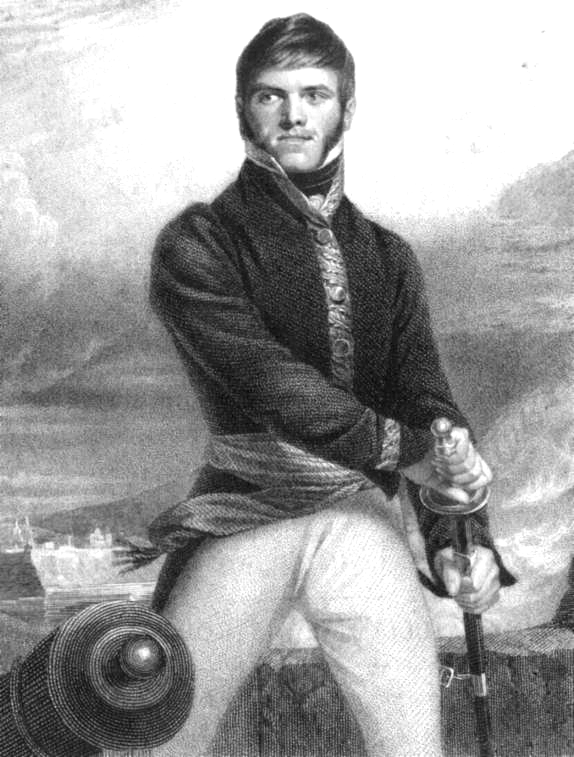
I will have my yearly dose of “asado” before visiting the Museo Nacional de Bellas Artes for an exhibit on Martin Fierro, the 1920’s avant garde publication. Wondering through the exhibit, I cannot help to think about a forthcoming event in California where Stanford and Berkeley will host a joint exhibit in September 2010 to celebrate Mexico’s Independence Bicentennial and the 100th Anniversary of the Revolution. My ongoing dreams about Pancho Villa, Emilino Zapata, and independence heroes Vicente Guerrero and Xavier Mina are a constant reminder that the due date approaches. At least mine are “heroic dreams,” not nightmares.

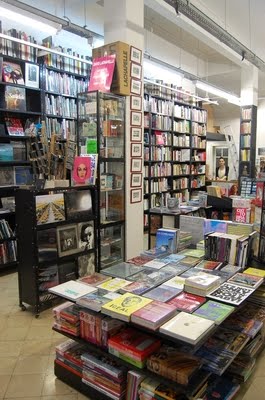
Monday, April 20th. This morning Phil MacLeod (Emory University) and I will follow a “recorrido libresco” up Avenida Corrientes home to many a bookstore. A pre-book fair outing that will supplement what awaits us the next day. It’s more manageable to visit “librerías” that carry the kind of materials of interest to an academic audience like ours.

Asunto Impreso’s Librería de la Imagen appears to be closer to our hotel than in previous years, perhaps is the pleasant weather that makes the recorrido seem less cumbersome. Along the way we stop by the place where last year I found the movie outlet Blackman, familiar to us all for it’s wide selection of Argentine films. But the office is closed (it’s past 11:30am and there is no indication of when it will open).

When we arrive the art bookstore, Alfonso Vijil is just leaving and points to the new women’s bookstore next door. It’s the one familiar to SALALM members from its previous location on same street where the Mothers of the Plaza de Mayo also have their coffee/book shop.

I alert Phil that books will all be wrapped in plastic and we'll have to ask the staff to unwrap them. Surprisingly, not all of them are and we are able to browse at the “novedades” shelf with much ease. Perhaps the publisher headed my plea a few months ago at the Bogotá book fair when I complained, actually, suggested that at least an “ejemplar de muestra” be available.

I jotted down several titles, and purchased one for the library the bilingual book *Arte naïf : libros de notas : una visión poética de la vida : 34 artistas Argentinos (OCLC: 47841717), although this is a special edition in a case and with some original prints.

For my own collection I purchase: *Body Politics. Políticas del cuerpo en la fotografía latino-americana (OCLC: 495778935); and *Desnudos sudamericanos (OCLC: 516281697), which appears to be available also as a photo portfolio, but that’s beyond my budget. A set of the photos has been on exhibit in Los Angeles until just a few days ago.


We now move next door to the women’s bookshop, where I take down many more titles, which I will have to reconstruct from memory since I lost my ubiquitous notebook on the last day of the fair!

On the way back to the hotel, I recognize the restaurant where last year Teresa Chapa (UNC-Chapel Hill) and I had our very own “comida casera,” It’s just before the lunch rush hour and we go in for an early meal so that we can make it on time for the matinee showing of this years Oscar winner for best foreign film, EL Secreto de tus ojos, which just a few days ago has opened in selected cities in the United States.

For dinner I will meet a friend from my UC-Santa Barbara days. He lives in the northern section of Belgrano and does not teach on Mondays and has agreed to meet me for an early dinner, early for him, but way too late for me at 8:30pm.

Tuesday, April 21st. Today will be the second part of our “paseo imperdible” up Avenida Corrientes, this time all the way to the Callao intersection….looking for…..books, what else. The vibrant publishing industry of Buenos Aires has been recognized by the Ministerio de Desarrollo Económico not only as a worthy enterprise but also one of commercial value celebrated with a “Noche de Librerías”.

Our first stop will be Antigona, which has expanded into the Centro Cultural de la Cooperación that houses a series of performance spaces and a coffee shop. We spend most of the morning there, probably annoying other customers with our constant “have you seen this book? And this other one?” But, Phil will have to fill in the blanks…. my notes are gone in that notebook I lost on my last day at the book fair.

After lunch, I take a well deserved rest and catch up reading the dailies I have accumulated during the past 48 hours: La Nación, The Buenos Aires Herald and the Argentine edition of Spain’s El País. There is already some press coverage of the book fair that opens the next day, one day shorter for the “días de profesionales,” but still 3 weeks for the general public.

Wednesday, April 22nd. Our visit to the fair grounds at La Rural will start with an early bus ride at 8:30am. The group of 7 Reforma and SALALM librarians and a few other US distributors is being generously supported by Fundacion ExportAr. After a brief meeting/reception with book fair dignitaries, some of us will hit the aisles, while others will meet publishers. Our task for the next 2 days will be, “comprar, mucho, pero mucho” as we have been instructed by our hosts,

During one of the first meetings with publishers when I explained that we work with distributors, he gave me a copy of booklet on the Editores del Plata, which brings together several independent publishers in an attempt to compete with both large publishers and distributors.

Thursday, April 23rd. Today will be a continuation of the previous day, meeting with publishers, visiting stands, check the OPAC.... While visiting the almost hidden section that housed the combined regional Argentine research centers I saw fellow SALALMista Peter Alterkrüger from Berlin's Ibero-Amerikanisches Institut. He did not see me until the following day when I was madly in search of my lost notebook.

To end the evening it will be dinner with one of SALALAM’s vendors in Uruguay (Luis and Carlos Retta). They seem to have convinced Colombian vendor Angela Silva Castillo (Siglo del Hombre) to attend the upcoming Brown conference this July. She already who knows several SALALMistas from the Bogota and Guadalajara book fairs.

Friday, April 23th. Last day, which we know share with the general public. I am seated by the Clarín stand, which competes with La Nación, not only for daily readers but also for space at the fair main entrance. I am joined at my table by a pair of older ladies with whom I share my copy of La Nacion’s literary supplement, adn Cultura lo importante es leer, no importa que sea de la competencia,” says one of them. When I ask what time it is, the other one shows me her watch and says, “elije vos a tu gusto,” the same response she got from a youngster when she asked the same question. It’s almost 6pm and the closing reception for "Profesionales" is about to start, so I bid my farewell to them as they join the thousands of "porteños" who have come to "curiosear," through all the many aisles overflowing with books.

Saturday, April 24th. One last minute visit will be to a DVD store that sells a variety of Argentine films. We thought they opened at 10am and arrived promptly at 10:05. When the sales clerk arrived at 10:15 and saw 2 SALAMistas and 1 Reformista, I thought he would close the door and wait until 10:30. But he welcomed us inside the small locale. Little did he know that we would drive him crazy: me asking for the same movies that Phil had bought a few days earlier and Alfonso Vijil saying he also wanted a set…plus a few more he needed.

If my Buenos Aires trip started with a visit to a museum, it was very fitting that it should end with a similar visit, to the MALBA’s show on art of the Cuban avant garde. I had no more room in my carry on luggage, so I exercised restraint while visiting the museum bookshop. Besides, I was already late for the hotel check out and would be heading for the airport soon.

As I mentioned earlier, I lost my notebook with multiple book titles and diary entries, but here are some titles of interest. For public and academic libraries:


*Editorial Capital Intelectual
El Atlas III: Un mundo al revés. De la hegemonía occidental al policentrismo. It's part of series that includes Atlas de las religiones (OCLC: 497187406, already at Los Angeles Public Library); and Atlas del Medio Ambiente. They are translated from the French by Le Monde Diplomatique and can be a good reference source.

*Editorial el Maizal has a series of books on various aspects of Argentine life: tango, wines, gauchos as well two others on native Mapuche culture

*From La Marca Editores the Registro Gráfico series includes some bilingual titles that supplement those from Maizal above.

*Editorial Heliasta has several dictionaries on law and business, some bilingual (see the diccionarios section at their site)

*Retina Editores has an interesting book, Potrero, on soccer culture in Argentina's working class neighborhoods (OCLC: 271111308).

For Academic Libraries:
From Retina Editores,
SANGRE/ BLOOD: Buenos Aires - Rio de Janeiro -México DF – Medellín (by Diego Levy) documents violence throughout some of the major metropolitan areas in Latin America.

Poesía diaria: porque el silencio es mortal (a series of “desaparecido” notices that appeared in the daily Página 12, OCLC: 213098498)

From Editorial Aquilina
A series of detective fiction titles seemed to be of potential interest to our literary clientele, especially 1-2 graphic novels. A virtual browsing through their recent published titles is possible, giving it "hip" sense of it all, right?

You can also see read some of the "prensa" generated by this new/independent publisher.

Photo of SALAMistas courtesy of Luis Retta.
L-r: Phil Mcleod, Carlos Retta, Adan Griego, Alfonso Vijil, Luis Retta and Angela Silva Castillo.

Closing reception photo courtesy of Maria Kramer (Redwood City Public Library, California)

Tuesday, April 13, 2010

XIX International Book Fair in Habana, Cuba. February 11-21, 2010


By Martha Mantilla

I traveled to Cuba using Pitt’s Center for Latin American Studies license and Title VI funding for book acquisition trips. The administrators from CLAS advised me to request my visa, plane ticket and hotel accommodations through MARAZUL, a travel agency located in NY.

I got my initial taste of Cuba at JFK airport in New York. From the time I joined the other passengers of this charter flight, I felt like part of a very large Cuban family traveling together. Most of them were Cubans living in the US.

Before boarding the airplane, we spent four hours making three different lines: one to get our boarding passes, another to check- in our baggage and one more to pay the airport fees. While we stand in line, people were spontaneously sharing their reasons for their travel, telling stories about live in Cuba and giving tips on what to do to avoid extra charges at the José Martí international airport in Habana. I learned that in addition to paying at the JFK airport for the luggage, we would also have to pay at the José Martí airport. The general view of the Cuban travelers was that their Cuban compatriots would try to overcharge them for their luggage. Thus, they were a little bit concerned about that. Traveling with a lot of stuff was almost the norm for most passengers since they were bringing food, medicines, and other things to their families and friends.

I engaged in a very lively conversation with the people standing besides me on the lines. I asked one of them the reason for his travel and the length of his stay in Cuba. He said that his trip was going to be short: he was going to Havana to shave Castro’s beard and come back. I started laughing! I later learned that this compatriota from Medellín, Colombia, was actually not traveling to Cuba. He was helping a Cuban passenger carrying all his stuff: suitcases, boxes, and more. My time at the airport was spent between reading “La sombra del viento” de Carlos Ruiz Zafón and listening to the most fascinating and lively conversations.

I was lucky from the start. The man next to my seat in the airplane was the eighty-year old Cuban who had spent most of the morning at the airport singing coplas that he would compose on the spot. His nice told me that it was very common for him to make coplas related to the situation he was experiencing at that particular moment and sing them. This sweet viejito coplero kept singing from time to time with joy and humor. We arrived in Havana as scheduled. I went through immigration and customs without trouble and did not have to pay any luggage fees for my tiny suitcase. The representative from MARAZUL helped me to change money and put me on a taxi on my way to hotel Vedado. I felt the wonderful breeze of the sea, saw again the lights of the Malecón and wonderful memories came back. I had been in Cuba in four previous occasions, the last one in 2000. I noticed changes on the streets. I saw Pullman buses used tourists and public transportation as well as modern cars of recent models and different makers. I did not recall seeing those on my previous trips. The bicycles and well-known old Cuban automobiles were also populating the Havana streets.

The next day I went to the Hotel Nacional, two blocks from the Vedado, to change money to CUCs. I started a conversation with a Cuban who kindly took me to a Casa de Cambios to get moneda nacional, which I needed it for buying books at the Book Fair. Many books at the fair and on the street are sold in moneda nacional. My next step was to get to the Fortaleza San Carlos de la Cabaña the fortress where the Book Fair took place. Located on the east side of the Havana Bay, this is an impressive fortress with XVIIIth Century walls. Every night at 9 p.m., soldiers dressed in suits of the epoch shoot “el cañonazo de las nueve”, (the gunshot of the nine). I took a taxi to get there. I had learned about taxis, mostly used by foreigners, which are easily recognizable and clearly marked. The jitney-like cars (colectivos), on the other hand, are basically for the Cubans. Taxis are to be paid in CUCs, thus significantly more expensive than the jitney-like cars, which are paid in moneda nacional. Some Cubans I met, being somewhat concern about me paying for taxis, wanted me to ride with them in the jitney-like cars. Indeed, I rode a jitney-like car once with a Cuban guy that I met at the Book Fair. He asked me to keep my mouth shut while riding the car because he did not want the driver to know that I was not a native. As a foreigner, I was not supposed to ride the jitney-like cars. He later offered to get for me a “cuban outfit” so that I would blend in more easily, to which I politely declined.

One of the highlights of my trip was a memorable tour that Joaquín Borges Triana gave me of Havana Vieja. We had met by e-mail when he contacted me in 2009 about his newly published book “Concierto cubano/Cuban Concert”. In our exchange of e-mails, we agreed on having coffee together if I ever traveled to Cuba. We met at the Café Escorial, a very cozy place in a beautifully renovated building with a tradition in coffee business located in la Plaza Vieja. While we walked through the narrow streets of Old Havana, Joaquín gave me a little bit of history of some of the buildings: Hotel Plaza, Gran Teatro de la Habana, the Cathedral. We stopped at the Biblioteca Publica Provincial and met Joaquín’s friend Gretell Lobelle, the Director of the library, who gave us a tour. I was very impressed with the facilities and the services of this public library as well as the José Martí Public Library, which I also visited.

What I admired the most, in both libraries, were the rooms for services to the blind and vision-impaired. Fully equipped with the latest equipment and computer technology, these rooms were attended by vision-impaired librarians trained in the use of the latest computer technology for the blind and vision-impaired users. I remember the librarian at the José Martí Public Library telling me about the endless doors that the new computer technology has opened for the blind.

At the Book Fair, I attended the presentation of Joaquin’s latest book, “La luz, bróder, la luz: Canción Cubana Contemporánea”. He introduced me to some of his friends including Victor Casaus, Director of the Centro Cultural Pablo de la Torriente Brau. This Center seeks to rescue and maintain alive the collective memory of the Cuban nation through a program called MEMORIA devoted to the research and promotion of Cuban oral history. The Centro Pablo held a number of activities commemorating the birth centennial of Miguel Hernández, including presentations of a new generation of Cuban TROVADORES in the fair’s Programa Artistico Cultural held throughout the city. I also met Fidel Díaz Castro at the Book Fair who is the Director of the Caimán Barbudo. He kindly gave me several publications including issues of Caimán Barbudo to fill gaps of the Pitt’s Latin American Collection.

I visited the Instituto Cubano del Arte e Industria inematografica (ICAIC) together with Patricia Figueroa and we met with Lic. Rosa María Rovira García, Directora de Relaciones Internacionales. We talked about the Cuban Film Series that Pitt is planning for the Fall and the experience in Brown with a similar program. I also visited the Instituo Cubano de Investigación Cultural Juan Marinello and made exchange agreements. I bought some of the library materials although many of them were given to me as gifts for Pitt’s LA collection. The generosity of the Cuban people never cease to amaze me. On this trip I was reminded, once more, of the generosity that was afforded to me during a conference in Education that I attended in the mid 90s during the Período Especial. Eventhough the mid 90s were a period of economic hardship, I was tremendously moved by a teacher who gave me a gift of a T-Shirt, which I had complemented it the day before when I saw her wearing it. Once again, on this recent trip, I was surprised when a book vendor took his scarf off and gave it to me after I had completed it. The gratitude one feels, for their generosity, is hard to express in words.

My Book Fair trip to this beautiful island in the Caribbean was unforgettable. I made time to walk in the Malecón, the avenue that runs along the seawall at the northern shore of Havana, had a meal with a Cuban family, attended a concert of the Cuban Van Van and another concert of Polito Ibáñez in the teatro Mella. I met wonderful people along the way. Our exchange of e-mails is already working well. The packages with the books, journals, CDs and other materials that I acquired in Cuban are arriving safely to Pittsburgh. My fear that the materials would be lost in the mail is gone. I am already starting to dream about my next trip to Cuba.

Friday, April 2, 2010

SALALM/JCB workshop on the History of the Book in Mexico -- JULY 28, 2010

Given the interest expressed on the SALALM Pre-conference workshop on the "History of the Book in Mexico" on July 22nd, the instructor, Ken Ward, Maury A. Bromsen Curator of Latin American Books at the John Carter Brown Library, has agreed to offer a repeat session on July 28th. This session is open to anyone interested. Attending the SALALM congress is no longer a requirement. We have about 14 seats open at present.

Those interested in registering for this workshop may use the registration form found in: http://library.brown.edu/salalm2010/pre_conference.html

The registration fee is $100.00

All forms and checks for this workshop should be mailed directly to Ken Ward at the John Carter Brown Library. The address is indicated in the form.

Overview of the program:
Session 1: "History of the Book in Spain and Latin America"
Session 2: "History of the Book in Mexico"
Session 3: "The Role of Women in Printing and the Book Trades in Mexico"
Session 4: "Collection Development in Colonial Mexico - Monastic Libraries and Private Collectors"

A list of suggested readings for each section will be provided, and each session will feature materials drawn from the John Carter Brown's Library collection.

Please note that registration for the July 22nd JCB workshop is now closed. We are only accepting registrations for the July 28th repeat session.

If you have any question, please contact Ken Ward directly at Kenneth_Ward@brown.edu.

Friday, March 26, 2010

Julio Herrera y Reissig: La mejor de las fieras humanas


Julio Herrera y Reissig: La mejor de las fieras humanas

"Este sitio está dedicado a Julio Herrera y Reissig. Aquí se puede leer su poesía, observar facsimilares, imágenes y piezas olvidadas. También incluyo las repercusiones críticas de mi biografía del personaje [La mejor de las fieras humanas. Vida de Julio Herrera y Reissig. Montevideo: Taurus, 2010] y discusiones conexas."

Proyecto del Prof. Aldo Mazzucchelli, Hispanic Studies Department, Brown University.

PUBLICACIONES PERIÓDICAS DEL URUGUAY


"PUBLICACIONES PERIÓDICAS DEL URUGUAY presenta la construcción progresiva de un sitio dedicado a la difusión, en formato digital, de periódicos que se publicaron en el Uruguay desde su constitución como país independiente y, aún antes, en la última etapa de la época colonial y durante los años de incertidumbre y conflictos que le sucedieron.
La prensa fue el espacio fundacional de discursos y discusiones, un ámbito propicio para la información de acontecimientos y disquisiciones intelectuales, de posiciones políticas, de aventuras literarias y artísticas, de miradas críticas rigurosas o polémicas, refiriendo tiempos y circunstancias, desde instancias que, dados los recursos tecnológicos actuales y sus incontenibles innovaciones, seguirán prolongándose.

Asimismo se podrán leer, en este sitio, las numerosas publicaciones organizadas o sostenidas por exilados e inmigrantes. Acontecimientos decisivos de la historia nacional se vieron reflejados en muchas de ellas (en italiano, francés, portugués e inglés, entre otras lenguas), por lo que son valioso testimonio tanto de la experiencia de una realidad extraña y nueva, la nuestra, como de los intereses y posiciones de los recién llegados ante sucesos locales y extranjeros.

Efímeras o duraderas, influyentes o marginales, sus páginas sorprenden por la multiplicidad de sus planteos, muchos de ellos todavía vigentes; sorprenden, algunas veces, por la belleza de su diagramación; otras veces, por la calidad de sus contenidos y los elevados atributos de sus colaboradores, por la gracia y humor de sus ocurrencias, por la virulenta severidad de las diatribas pero también, y en casi todos los casos, por el lamentable desconocimiento general en el que hoy se encuentran. Rescatadas y difundidas, son huellas y reliquias de vicisitudes y visiones que podrán favorecer la consolidación de nuevas reflexiones, de invenciones, de iniciativas de la imaginación que, gracias a las redes y sus tecnologías, habilitan el acceso a un tiempo que pasó y aún nos concierne."