After a constant "vaiven" of back to back activities, the 2nd day of SALALM's internal meetings seemed less hectic but with just as intense discussions on a variety of topics.
The "libreros" gathering provided a forum for SALALM's vendors to address issues like the constant reduction of library budgets (will it ever end?) and how to position themselves as independent booksellers to face the competition from the larger and better funded media conglommerates. At some level it's preaching to the converted (we in SALALM) that vendors based in Latin America go the extra mile in trying to locate materials that dealers in the United States may not be able to do OR are not willing to do.
A much anticipated post-lunch meeting (e-SALALM discussion) drew a standing room only audience. We focused on ways in which the organization can transition into an electronic environment, make better use of emerging technologies and have a more dynamic online presence.
As participants approached the registration area, they could not miss the many souvenirs displayed on an overflowing table nearby. These are the items being raffled to raise funds for the Enlace/Outreach Subcommittee that for more than 20 years has been granting scholarships to bring Latin American information professionals to participate at SALALM annual conferences.
Stay tuned for tomorrow for a report on the keynote speech and much more.

Saturday, July 24, 2010

SALALM's 55th Annual Meeting from Providence.
More than 180 SALALM members (librarians,vendors and visitors) have gathered at Providence for the group's annual meeting which started on Thursday (July 22nd) and is being hosted by Brown University.
SALALM's professional activities started with two pre-conferences:
1) An eclectic group of 22 SALAMistas enjoyed a unique experience: studying rare books dating back to the 17th century as part of the "History of the Book in Mexico" seminar.
2) A similarly eager group of 7 professionals new to Latin American Studies learned about collection development where topics ranged from Spanish-language publishing to the ever-present discussion of everything digital (e-books, e-journals...).
The first day of internal meetings (Friday, July 23rd) provided a full agenda where veteran librarians, vendors from Latin America and Europe and few newcomers participated in discussions on a wide variety of topics of interest beyond Latin American Studies Librarianship: reference services and BI in a digital environment; electronic resources; reduced budgets; cooperative collection development projects, etc.
It is all part of the umbrella of the conference's theme: "The Future of Latin American Library Collections and Research: Contributing and Adapting to Trends in Research Libraries."
As good colleague and friend from the other side of the Rhode Island borders says: more as it happens.
Wednesday, July 21, 2010
Dear loyal blog readers,
Just sending along another plug for our eSALALM session on Saturday, thinking that this kind of stuff might be especially interesting to those of you who are part of our blogosphere. See some of you soon! //pamela
------------------------------------------------------------------------------------------------------------------------------------------------
A reminder that we will be holding an e-SALALM Discussion on Saturday, July 24th, 1:30 – 2:30 p.m. in State Suite B of the Providence Biltmore.
Please join us to discuss and provide feedback on several topics related to using technology and the internet to disseminate information about SALALM. The discussion will focus on the following topics and we welcome the attendance and input of all SALALM members.
SALALM Newsletter -- possibilities and opportunities for online publishing of newsletter content (a recommendation from the Editorial Board will be distributed via LALA-L prior to the conference)
SALALM Publications-- options for online access and publishing of SALALM content (conference papers, etc.)
Webinars -- opportunities for engaging in training and sharing SALALM expertise via webinars
For members who won't be attending the conference next week, please contact us with any ideas and suggestions related to these topics.
Thanks!
Thursday, July 15, 2010
Pecha Kucha: SALALM LV
I'd like to invite you all to attend SALALM's inaugural Pecha Kucha!
Also many other thrilling presentations; see the Program for more details.
See you there!
Alison H
Wednesday, June 16, 2010
Exhibits on Latin America at Brown University during the SALALM LV Congress
John Hay Library
20 Prospect St. (12 minute walk from the Biltmore Hotel)
Monday - Friday 10:00-5:00
John Carter Brown Library
94 George St. (13 minute walk from the Biltmore Hotel)
Monday - Friday 8:30-5:00, Saturday 9:00-12:00
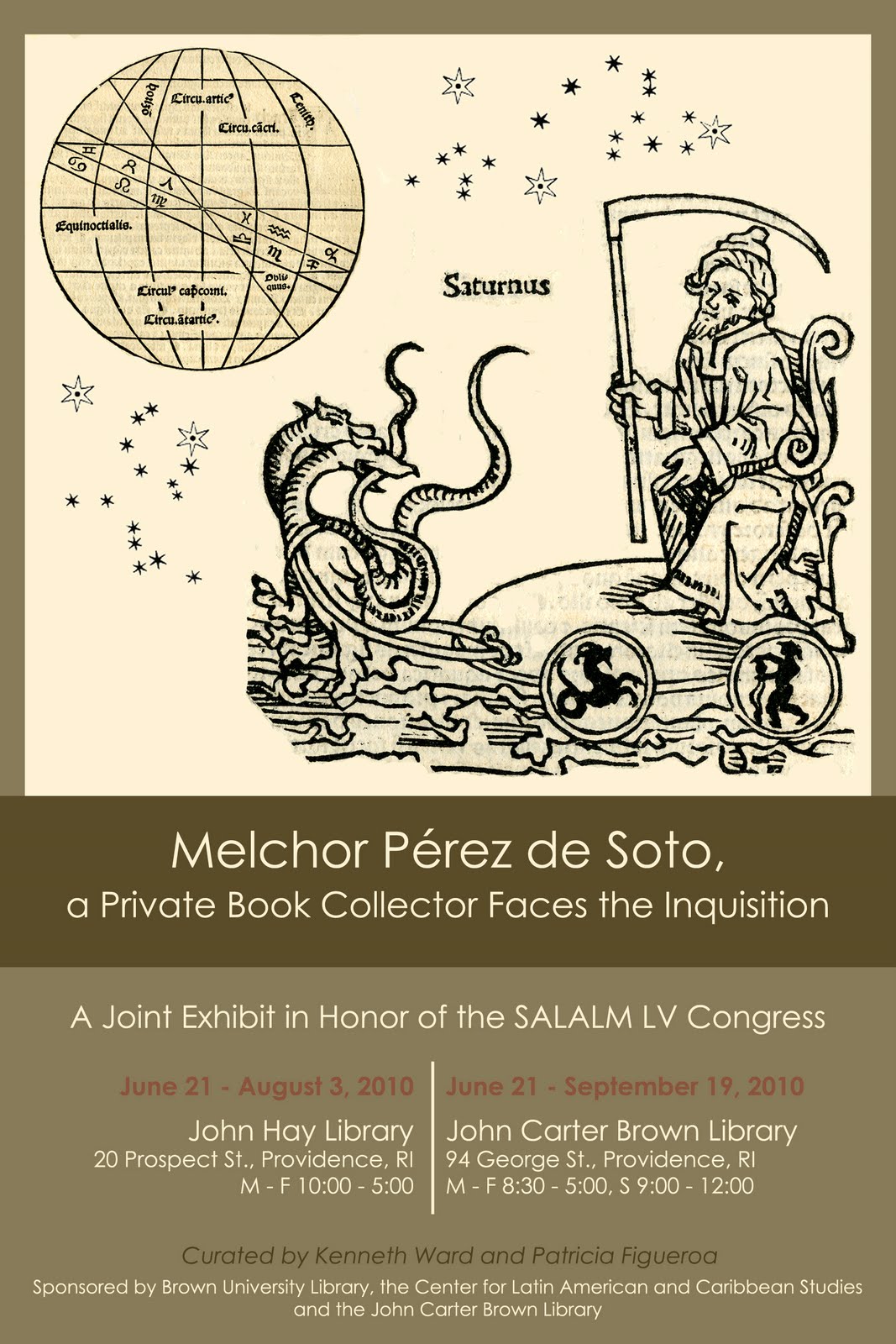
Pérez de Soto, a Book Collector Faces the Inquisition
A joint exhibition in honor of the SALALM LV Congress. Melchor Pérez de Soto, a Mexican astrologer and architect, built one of the most impressive private collections of printed books in 17th Century Mexico. According to an inventory of its library made by clerks of the Inquisition, the collection contained 1,592 volumes, covered various disciplines, and represented authors from the classical to contemporary periods. During the last five years of his life, the Holy Office gathered evidence on perceived heretical activities carried out by Pérez de Soto which included practicing astrology and owning prohibited books. He was arrested by the officers of the Inquisition on January 13, 1655, and spent several weeks in solitary confinement. He was found dead in his prison cell on March 17 of the same year. This exhibit illustrates the depth and breadth of the Pérez de Soto private collection and provides a glimpse into one of the finest minds among humanists in colonial Mexico.
Haffenreffer Museum of Anthropology at Manning Hall
Campus Green (13 minute walk from the Biltmore Hotel)
Tuesday - Sunday 10-4
Reimagining the Americas
This exhibit brings together innovative anthropological ideas and evocative artifacts from the Amazon to the Arctic to plumb the cultural diversity of the Americas before European contact and explore the forgotten histories of its indigenous people. Building on recent discoveries and methods developed by archaeologists and anthropologists over the past decades, Reimagining the Americas uses cutting-edge perspectives to illustrate intriguing, often complex, histories through artifacts of ceramic and stone, jade and gold, bone and textiles that illuminate the past and expose themes that resonate with present and future concerns. From the arrival of humans in the Americas to the rediscovery of ancient Amazonian cultures and the deciphering of lost histories written by the Maya and Aztec, Reimagining the Americas challenges us to rethink the past and to recognize 13,000 years of indigenous achievements before Europe looked to the west.
Monday, May 17, 2010
Ibero American Cinema at Harvard

El cine como historia; la historia como cine: Simposio internacional sobre cine iberoamericano was held at the Harvard University Film Archive from May 7-9, 2010.
Among the many presenters were Néstor García Canclini (UNAM), who wondered (as did other presenters) whether there is such a thing as Ibero American cinema in this age of co productions, television-sponsored films (HBO), and international financing. Juana Suárez (Univ. of Kentucky) and Gonzalo Aguilar (U. Buenos Aires) spoke about the international and multi-national nature of Ibero American film as well.
Historical memory and documentary film in Spain was a major topic, addressed by Ignacio Oliva Mompeán (Univ. de Castilla-La Mancha), Francisco A. Zurian (Univ. Carlos III) and Josetxo Cerdán (Univ. Rovira I Virgili). Oliva Mompeán discussed films made outside of Spain that address events of the Spanish Civil War: Muerte en el valle (Cristina Hardt) and Land and Freedom (Ken Loach) are two of them; to date few films addressing historical memory of the period have been made in Spain. He referenced the website “Imágenes contra el olvido” (http://www.
From Cuba, Juan Antonio García Borrero (Camaguey) spoke about “ICAICentrismo” in Cuban film history, mentioning films produced by organizations and people outside of Cuban National Film Institute, and Luciano Castillo (San Antonio de los Baños) discussed the productions of Cuba Sono Film. Both García Borrero and Castillo have published extensively on film in Cuba.
Other notable speakers were Jorge Ruffinelli (Stanford Univ.), who discussed the work of Glauber Rocha while in Cuba; Román Gubern (Univ. de Barcelona), on anti-Semitism in Spanish postwar cinema, and Leonardo García Tsao (Cineteca Nacional de México) on Mexican cinema.
Laura Baigorri (Univ. de Barcelona) gave a presentation on video art in Latin America and discussed the project “Videoarde” (http://videoarde.com/). This presents a series of workshops, links, and publications; she hopes to develop a database of Latin American video art as part of the project.
The Colombian film director Víctor Gaviria presented three of his films: Vendedora de rosas, Medellín: sumas y restas and Rodrigo D no futuro and held discussions after each with Jorge Ruffinelli.
Jet setting librarians Patricia Figueroa (Brown Univ.), Jesús Alonso Regalado (SUNY Albany) and Lynn Shirey (Harvard) were in attendance and purchased copies of titles on Cuban film for their collections.
Lynn Shirey (Harvard University)
Thursday, May 13, 2010
Subject Guides 2.0 continued...
Lists of web links were one of the biggest headaches of 1.0 subject guides. Links went out of date or got hijacked, and the long list of text was overwhelming. While the question of cataloging and archiving free web links is far from being resolved, there are a now a few options to make this an easier process. Intute, from the University of Oxford, is a database of links to academic web resources [disclaimer; I used to work for Intute] and it allows you to embed their search box on your page. Intute resources are evaluated by librarians and are strongest in Iberian resources.
LANIC remains the strongest for Latin American resources [disclaimer; I used to work for LANIC.] Thanks to Kent Norsworthy, LANIC search boxes that search the LANIC site, the LAOAP project or the e-text collection can also now be embedded on your page. For both resources, researchers will search from your page but the results page is part of Intute or LANIC's site.
If these resources don't give you the flexibility that is needed, it is very easy to create and embed your own search engine that searches a specific subset of websites. Simply select the web pages that you wish to search and Rollyo or Google Custom Search will allow you to create and embed your own mini search engine. The easiest option is Google's On the Fly Search box, which makes an existing page of links, blog or directory searchable, with no account needed. A final option would be to tag useful websites in a social bookmarking tool, such as delicious. It is then possible to display your links as a linkroll (list of new links) or as a tagroll (cloud of new tags) on your page. All these link tools present information in a visually attractive way, and take the hassle out of updating pages of links. By adding a widget or direct connection to the resource, you're making the search process more visible and attractive too.
While all these tools make it much easier to ensure that your page contains the most accurate and up to date resources, it's often impossible to work on web pages regularly. There are a few tricks though, that give the impression that your page is constantly being updated, while also helping contribute to the learning community atmosphere. This is where those RSS tools that you learned from one of my previous columns come into play...
Using a program such as Feedburner or Feedsource it is possible to embed appropriate RSS feeds into your webpage. (Libguides users don't have to use these tools- just select embed RSS feed.) An RSS feed is new content from a specific page, which is automatically updated. Using RSS on your subject guide is just another way to display current information for your subject area-here are some ideas for relevant feeds.
Instead of providing a long list of appropriate academic journal titles, you could embed the latest journal Table of Contents on your page. Try TicTocs for a list of RSS feeds from academic journals. Including relevant news on your page makes a lot of sense too- instead of enumerating useful news websites, use RSS to embed LANIC's Twitter feed of news stories, Molly Molloy's Frontera list serv or BBC headlines. You could even use RSS to bring in appropriate photos from Flickr or a photo sharing website. These tools help to break up the text based subject guide, as well as physically demonstrating to students what useful web resources exist.
A final key feature of the 2.0 subject guide is providing space for feedback and/or interaction. Web 2.0 is all about conversation and community; the idea that content is a shared process that isn't imposed top down. So enabling a comments feature, a poll for people to vote on different topics or an IM chat window ensures that there is a mechanism for communication and feedback, even if, in actual fact, very few people actually use this feature...
All of these features are quick, easy to implement, and achievable even if you don't use LibGuides. The tools allow you to present relevant information in a visually attractive and interactive way, that make the lost of a subject guide format.
(Quick Update: Thanks to Sócrates and Orchid from HAPI for putting the HAPI tutorials on Youtube. This means that they can easily be embedded on your page. Search for HAPI on the UCLA Youtube channel.)
Alison Hicks
alison.hicks @ colorado.edu
University of Colorado, Boulder
Subscribe to:
Posts (Atom)